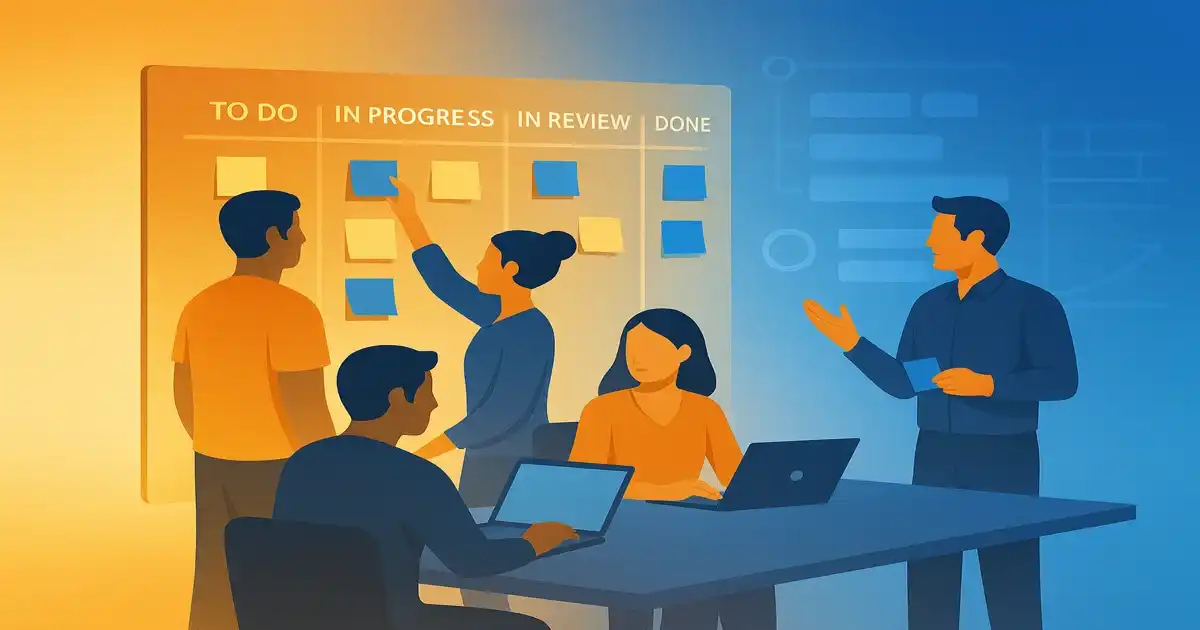
Insights from The Scrum Fieldbook
Section 1. Choice
Moore's Law predicts that the cost and size of transistors decrease yearly.
The Saab modular approach involves using parts as plug-ins on a main frame.
Scrum Values:
- The product is more important than documentation.
- Communication with the client is a top priority.
Section 2. How to Rethink Cheaply
Scrum Defines Three Key Roles:
- Product Owner
- Scrum Master
- Team Member
Sprint Stages:
- Sprint Planning
- Sprint Execution
- Daily Scrum
- Sprint Review
- Sprint Retrospective
Scrum Artifacts:
- Scrum Backlog
- Scrum Sprint
- Product Increment
The Product Owner defines the vision for the team and prioritizes tasks based on value.
How to Apply Scrum to House Repairs?
- Create modular tasks for changes.
- Plan the budget.
- Work iteratively.
- Show progress weekly.
Hempfry’s Law:
If you can’t determine what you want until you see what you don’t want, get feedback and adapt.
Use Scrum 3-5-3 (Roles - Actions - Artifacts).
Section 3. Why We Can’t Decide
- Apply the Eisenhower Matrix for decision-making.
- Decisions should take no more than an hour.
- If a decision takes longer, escalate it.
- Manage complexity through simplicity.
Section 4. In Progress vs. Completed
- Two tasks cannot be a priority at the same time.
- Define completion criteria before starting any task.
- If you don’t prioritize, the least competent employee will.
- Finish the previous task before starting a new one.
- Use a modular approach to reduce dependencies.
Section 5. If Something Seems Crazy, It Probably Is
- Challenge rules—someone is responsible for their implementation. Find them and ask why.
- Think critically about which outdated rules can be removed.
- Rules should justify their necessity.
- Zero-Sum Game: If I win, you lose.
- Private meetings foster better team understanding.
Section 6. Structure Defines Culture
- The worst problem is not realizing that a problem exists.
Scrum Core Values:
-
Honesty
-
Focus
-
Transparency
-
Respect
-
Minimal Bureaucracy
-
Feedback is crucial—get as much of it as possible for growth.
-
Your culture sets the limits of your success.
Section 7. How to Do It Right
Patterns exist in every industry, including architecture.
Using patterns ensures scalability.
Team Formation Stages:
- Forming – individuals set personal boundaries.
- Storming – conflicts arise, and personal boundaries are tested.
- Normalizing – team members adapt and distribute tasks correctly.
- Performing – energy aligns for collective success.
The art of conversation is essential—Scrum is built on communication.
The Swarm Technique, where the entire team tackles one task together, ensures faster completion.
Use a buffer for unplanned tasks and reserve it for urgent matters.
Scrum Emergency Procedure (If a Sprint Task Won’t Be Completed):
- Change the team’s working methods—try something different.
- Seek external help and delegate backlog items.
- Reduce workload and replan the sprint.
Every retrospective should result in at least one process improvement.
Scrum Templates:
- Swarm
- Distraction Buffer
- Emergency Stop
- Cleanliness Compliance
Section 8. How Not to Do It
- Identify anti-patterns in your workflow.
- Selective Scrum only works temporarily.
- If you want radical acceleration, use Scrum in full.
- Scrum generates large datasets—use them to remove subjectivity from decision-making.
- The best employees should work for your company.
Section 9. Organizational Rebirth
- If something isn’t working, don’t blame the people—blame the processes.
Section 10. What the Future Holds
- The world never stands still—everything is possible.
- What was considered unrealistic yesterday may be common practice today.
Conclusion
J.J. Sutherland's The Scrum Fieldbook provides a practical approach to implementing Scrum beyond software development. By focusing on team collaboration, decision-making efficiency, and continuous process improvement, organizations can achieve greater agility and productivity. The book reinforces the idea that Scrum is not just a framework but a mindset that drives innovation and sustainable success.
Frequently Asked Questions
Q: What is Scrum methodology?
Scrum is an agile framework for managing complex projects through iterative development cycles called sprints (typically 2-4 weeks). It emphasizes: small self-organizing teams, incremental delivery, regular inspection and adaptation, transparency, and rapid feedback loops. Scrum originated in software development but applies to any complex work requiring flexibility, collaboration, and continuous improvement.
Q: What are the key roles in Scrum?
Scrum defines three roles: Product Owner (prioritizes work and represents stakeholders), Scrum Master (facilitates process and removes impediments), and Development Team (self-organizing group delivering work). The Product Owner decides what to build; the team decides how. This separation ensures clear responsibilities while maintaining team autonomy and preventing micro management that stifles productivity.
Q: What is a sprint in Scrum?
A sprint is a fixed time period (usually 2-4 weeks) during which a team completes a set amount of work. Each sprint includes: planning (selecting work), daily standups (coordinating), development (doing work), review (demonstrating results), and retrospective (improving process). Sprints create rhythm, enable rapid feedback, and allow course corrections based on actual progress and learning.
Q: What are daily standups and why are they important?
Daily standups are brief (15-minute) meetings where team members share: what they accomplished yesterday, what they'll do today, and any obstacles they face. Standups maintain alignment, surface impediments quickly, promote accountability, and keep everyone informed without lengthy status meetings. The key is keeping them short, focused, and action-oriented rather than problem-solving sessions.
Q: What is the difference between Scrum and traditional project management?
Traditional project management emphasizes upfront planning, detailed specifications, and sequential phases. Scrum embraces uncertainty, favoring adaptation over following plans. Traditional methods assume requirements are known and stable; Scrum expects change. Scrum delivers working increments frequently for feedback; traditional methods often deliver once at the end. Scrum prioritizes team autonomy; traditional methods emphasize managerial control.
Q: How do you measure success in Scrum?
Measure success through: working product delivered (not documentation or activity), velocity (amount completed per sprint), team satisfaction and engagement, customer satisfaction and feedback, sprint goals met, impediment resolution time, and continuous improvement in retrospectives. Focus on outcomes and value delivered rather than hours worked or tasks completed. Sustainable pace and team health matter alongside productivity.
Further Reading
Explore authoritative sources on Scrum and agile methodology:
- Scrum Guide (Official) - The definitive guide to Scrum framework by its creators
- Scrum.org Resources - Official Scrum training, certification, and community resources
- Agile Manifesto - The foundational principles of agile software development
- Scrum Fieldbook on Goodreads - Read reviews and practical implementation discussions
Related Reading
If you found this book insightful, you might also enjoy:
- The One Thing by Gary Keller - Focus and prioritization strategies for maximum impact
- The Jedi Way by Maxim Dorofeev - Task management and cognitive productivity techniques
- I Knew It All Along by Eliyahu Goldratt - Theory of Constraints and identifying bottlenecks
- Networking for Secret Agents by Bezrukov - Strategic relationship building and organizational dynamics
- The 7 Habits of Highly Effective Families by Stephen Covey - Proactive planning and collaborative principles