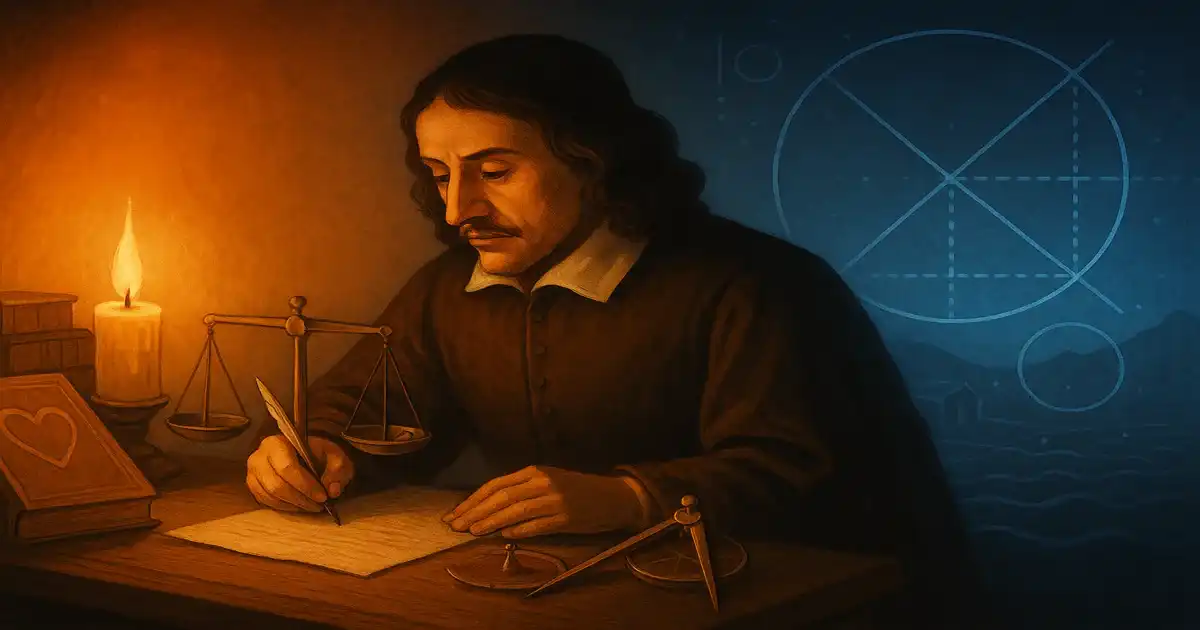
The Paradox of Faith and Reason
While logic and knowledge are powerful tools, Pascal argues that sincere faith holds greater significance in matters beyond human understanding. Faith, he suggests, is not an abandonment of reason but a complement to it.
Key Insights:
- Faith often addresses questions that logic cannot fully resolve.
- Reason provides a foundation for belief, but it is insufficient to grasp the divine or the infinite.
- True understanding begins with acknowledging the limits of human knowledge.
Pascal’s Wager: The Rationality of Faith
Pascal introduces the wager as a means of evaluating belief in God. His reasoning follows:
- If you believe in God and He exists, you gain eternal bliss.
- If you do not believe and He exists, the consequences are eternal suffering.
- If God does not exist, belief costs little but can still provide a moral and fulfilling life.
Thus, choosing faith is the most rational choice given the high stakes and uncertain conditions of human existence.
The Limits of Logical Proof
Pascal’s wager leads to a paradox: using logic to justify faith. Yet faith, by its nature, is often considered beyond logical validation.
- Logic cannot prove or disprove the existence of God.
- Faith is not based purely on reason, but on a personal and existential decision.
- Pascal does not claim that the wager proves God’s existence, but that faith is the most reasonable choice in a world of uncertainty.
Pascal’s Mystical Experience
A defining moment in Pascal’s life occurred on the night of November 23-24, 1654, when he had a profound mystical vision. He described it as a direct encounter with the God of Abraham, Isaac, and Jacob, not the God of philosophers.
- This experience deeply influenced his later life and writings.
- Pascal recorded his revelation on parchment and sewed it into his clothing, carrying it until his death.
- This event marked his transition from abstract contemplation to deep, personal faith.
The Role of Doubt in Faith
Pascal recognizes that doubt is an essential part of the journey toward faith. He proposes that:
- True faith requires the courage to question and seek.
- Faith and reason are not enemies but exist in a dynamic relationship.
- The search for meaning is continuous, requiring openness to both doubt and revelation.
Conclusion
Pascal's reflections offer a unique synthesis of logic and faith, suggesting that the human mind alone cannot fully grasp divine truths. Instead, faith is an act of courage and trust, embracing both the unknown and the limitations of reason.
Frequently Asked Questions
Q: What is Pascal's Wager?
Pascal's Wager argues believing in God is the most rational choice given uncertainty. If God exists and you believe, you gain eternal happiness; if He exists and you don't believe, eternal suffering. If God doesn't exist, belief costs little while providing moral framework. The wager favors faith based on risk-benefit analysis.
Q: Is Pascal's Wager a proof of God?
No, Pascal explicitly doesn't claim the wager proves God's existence. Instead, it argues belief is the most reasonable choice given life's uncertainties and high stakes. The wager addresses practical decision-making under uncertainty, not logical proof. Faith remains a personal existential decision beyond purely rational demonstration.
Q: What was Pascal's mystical experience?
On November 23-24, 1654, Pascal had a profound mystical vision lasting about two hours. He described it as a direct encounter with "the God of Abraham, Isaac, and Jacob," not philosophers' abstract God. He recorded this revelation on parchment and sewed it into his clothing, carrying it until death. This experience transformed his faith from intellectual to deeply personal.
Q: Can you use logic to justify faith?
Pascal's paradox: using logic to justify faith that transcends logic. He argues reason alone cannot fully grasp divine truths—faith complements but exceeds rational understanding. While logic provides foundation, faith addresses ultimate questions beyond reason's scope. Pascal demonstrates rational grounds for belief without claiming faith reduces to pure rationality.
Q: What is the role of doubt in Pascal's philosophy?
Pascal recognizes doubt as essential to the journey toward faith. True faith requires courage to question and seek rather than blind acceptance. Faith and reason exist in dynamic relationship, not opposition. The search for meaning continues through doubt and revelation. Acknowledging uncertainty makes authentic faith possible rather than impossible.
Q: How does Pascal differ from Descartes on faith and reason?
Descartes trusts reason to discover truth through methodical doubt and logical deduction. Pascal argues reason has limits and cannot answer ultimate questions without faith. While Descartes builds from "I think, therefore I am" through pure reason, Pascal emphasizes faith's necessity for grasping realities beyond rational demonstration, making faith existentially prior to complete understanding.
Further Reading
Explore authoritative sources on Pascal and his philosophy:
- Pascal on Stanford Encyclopedia of Philosophy - Comprehensive analysis of Pascal's Wager, Pensées, and contributions to philosophy and mathematics
- Pensées full text (Project Gutenberg) - Read Pascal's complete collection of philosophical fragments on faith, reason, and human nature
- Pascal - Internet Encyclopedia of Philosophy - Overview of Pascal's life, mathematical achievements, and philosophical legacy
- Pascal's Wager Explained (Stanford) - In-depth analysis of the famous argument for rational belief in God
Related Rationalist Philosophy
Explore reason, faith, and the limits of knowledge:
- Descartes I Think Therefore I Am - Descartes's rationalism provides the foundation Pascal challenges, showing how reason alone cannot answer ultimate questions
- Leibniz Best of All Possible Worlds - Leibniz's theodicy and optimistic rationalism offer a different approach to reconciling faith and reason
- Spinoza Pantheism - Spinoza's rational approach to divinity contrasts with Pascal's emphasis on personal mystical experience
Religion and Enlightenment Thought
Compare different Enlightenment perspectives on faith:
- Voltaire Critique of Atheism - Voltaire's deism and religious tolerance provide an alternative Enlightenment view on faith and reason
- Kant Justification of the Incomprehensible - Kant's limits of reason and categorical imperative build on Pascal's recognition of reason's boundaries
Skepticism and Knowledge
Explore radical doubt and epistemology:
- Hume Skepticism - Hume's empirical skepticism challenges both Pascal's wager and rationalist certainty about knowledge